
What are the 10 data items on an invoice that need to be accounted?
03/27/2023
by Tomás Marconi
Xtract
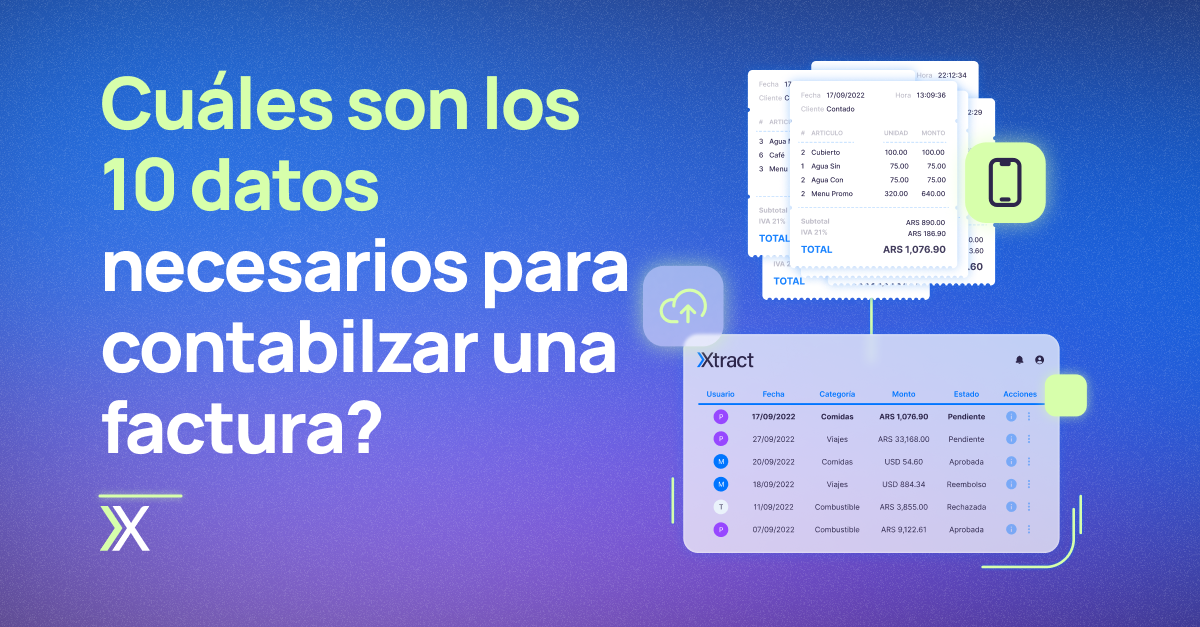
When managing a business, it is essential to keep accurate accounting records. One of the most important documents for bookkeeping is the invoice. However, not all invoices are the same, and it is necessary to know which data to collect to keep track of your expenses and revenues accurately.
In this article, we will explain which data on an invoice is essential to record to ensure that your accounting is impeccable.
- Date of issue and due date
The date of issue and due date of an invoice are critical pieces of information. The date of issue is the date on which the invoice was created, while the due date is the date on which payment is due.
Recording these dates is essential for keeping track of payment deadlines, making payments on time, and avoiding late payment fees.
2. Invoice number
Each invoice should have a unique invoice number that can be used to track payments and reconcile accounts. The invoice number should be sequential and easily identifiable.
By keeping track of invoice numbers, you can quickly identify which invoices have been paid, which are outstanding, and which need to be followed up.
3. Name and address of the supplier
The name and address of the supplier should be recorded to ensure that payments are made to the correct entity. Recording this information also makes it easier to identify and track payments made to the supplier.
4. Description and quantity of goods or services
The description and quantity of goods or services should be recorded to ensure that payments are made for the correct items or services. Recording this information also makes it easier to track inventory and manage stock levels.
5. Unit price and total amount
The unit price and total amount of the invoice should be recorded to ensure that payments are made for the correct amounts. Recording this information also makes it easier to track expenses and revenues accurately.
6. Taxes and discounts
Any taxes or discounts applied to the invoice should be recorded to ensure that payments are made for the correct amounts. Recording this information also makes it easier to track expenses and revenues accurately and calculate tax obligations.
In conclusion, keeping accurate accounting records is essential for any business. By recording the critical data on an invoice, you can ensure that your accounting is impeccable and avoid potential issues with payments, taxes, and inventory management.
7. Invoice Total
The invoice total is the total cost of the products or services invoiced. This data is essential for financial management and proper recording of the business transaction.
8. Taxes
Taxes are an important part of any invoice. Inclusion of taxes on the invoice is necessary for tax purposes and to ensure accuracy in accounting for costs.
9. Terms of Payment
Payment terms are the terms and conditions that are established for payment of the invoice. This information is crucial for financial management and planning.
10. Bank information
Bank information is required to make payment of the invoice. It is important to ensure that the information is accurate and up to date.
In conclusion, proper posting of an invoice is essential for the financial management of any company. The most important data to post includes the issue and due date, invoice number, name and address of the supplier and customer, detailed description of the goods or services, quantity and unit price, total amount of the goods or services, and the amount of the invoice.
Depending on the number of invoices received by the company, the entry of this data can take the entire work of several people.
In Retail companies, for example, the number of invoices posted per month per person is between 800 and 1100.
To speed up this task and allow the person to focus on the analysis and optimization of expenses rather than repetitive tasks, there is Xtract, which automatically reads large volumes of invoices and allows automatic posting in any ERP.
To start automating this process in your company you can contact our team from this link.
Latest entries

Recent highlights
There are no related entries

© 2026 Xtract.app


